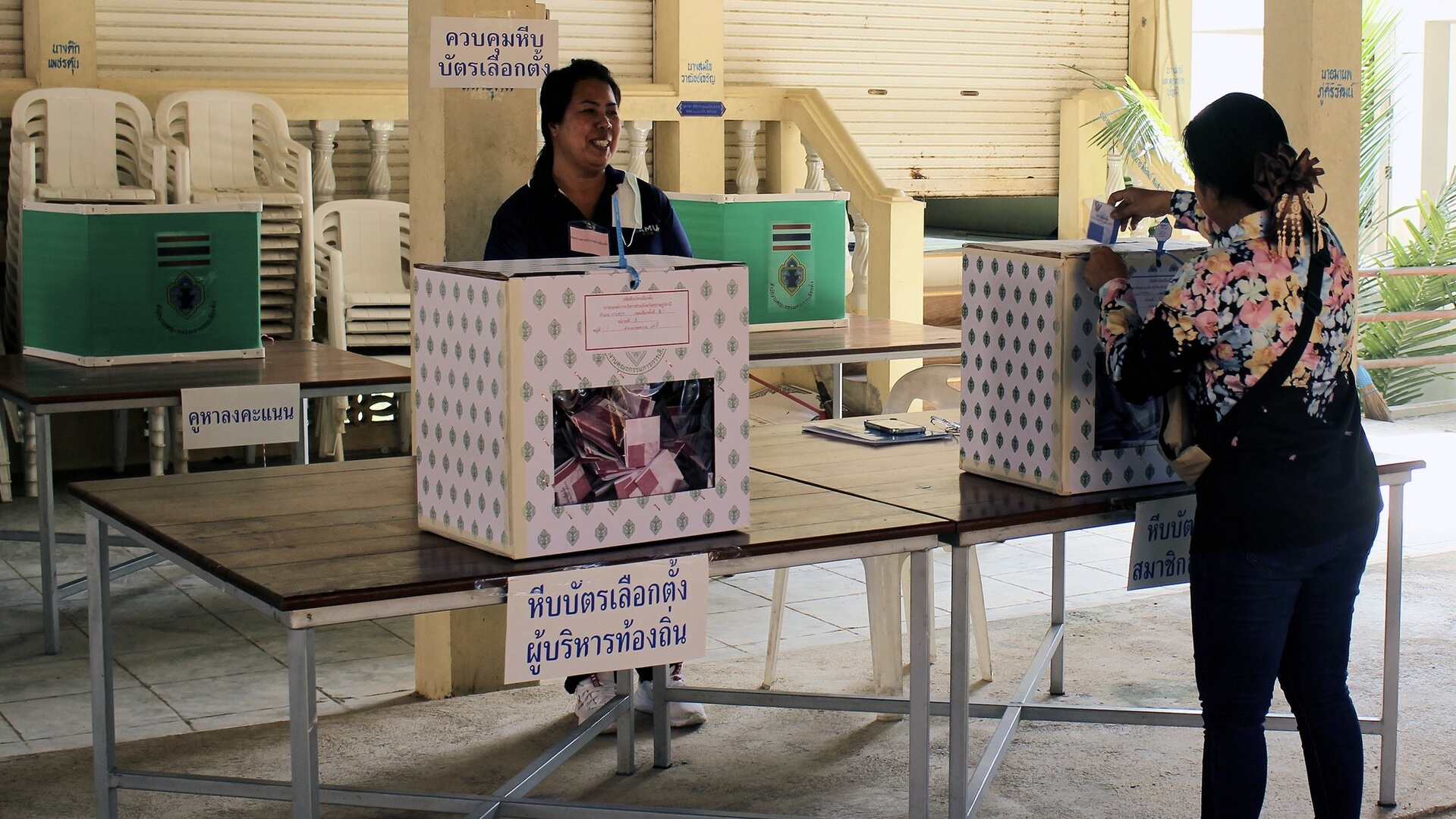
The dissolution of parliament came as a shock. We knew the Thai government was unstable; the two previous governments had collapsed. The country was in an on-off military conflict with Cambodia, the southern provinces of Thailand were flooded, and corruption and drug smuggling were rampant. Compounding this instability, no democratically elected government has completed a full term since Prime Minister Thaksin Shinawatra’s first term (2001-2005); the rest of the civilian governments were undermined repeatedly amid a series of military coups and obstructions by higher institutions. Like previous elections, Thailand is at a crossroads. Will the people elect the progressive anti-military opposition, or will they legitimize pro-military and oligarchic rule?
So, in this light, I scrambled to the embassy to renew my passport for the election. I panicked, thinking that my idleness in renewing my documents would lead to my disqualification from voting eligibility. I was in luck. The embassy staff were kind enough to assist me in registering to vote and renewing my travel documents. It is hard for me to say whether lasting systemic change can be achieved by just voting. Surely, voting is not enough as an individual choice performed once every few years; people need to organize. In parties, protests, unions, and associations, people have to stand up for democracy. For true democracy, not an illusory system of military-backed crony capitalism.
The previous Pheu Thai governments may not have been backed by the military (they were very much in conflict with the military and conservative establishment), but they still represented the interests of the Shinawatra clan and its business empire, as well as local political bosses, often alleged to at least turn a blind eye to corruption. Other elements of the Red-Shirt movement had previously fragmented to form parties like Khla Tam or Bhumjaithai, which are members of the current government, along with smaller pro-military parties, led by charming figures like Thamanat Prompow, widely reported to be a convicted heroin smuggler and murder suspect, and the current PM Anutin Charnvirakul of Bhumjaithai and his backer in Buriram, Newin Chidchob, who many consider to be associated with local patronage networks, fraught with criminal allegations, and the narcotics economy in provincial strongholds.
Thus, according to many observers, this election will show whether Thailand is ready for a progressive revolution or sticks to the conservative establishment. The People’s Party, led by Nattaphong Ruengpanyawut and Srikanya Tansakun, represents the progressive camp in the footsteps of previous anti-military champions Thanathorn Juangroongruangkit (Future Forward Party) and Pita Limjaroenrat (Move Forward Party, who have been barred from holding political office for dubious reasons. Polls suggest the People’s Party is slightly favored in the election, yet it remains to be seen whether they can form a majority government after the election on February 8. There is no longer a military-appointed Senate to block the election of a Prime Minister, but the Constitutional Court and the Bhumjaithai-controlled Senate (elected through a convoluted system) remain powerful forces that could stifle reform.
Additionally, a referendum scheduled on the same day will pave the way for a reform of the military-written 2017 constitution. However, Prime Minister Anutin has the cards in his hands, as his party has both the backing of the conservative establishment (as well as the Constitutional Court and Senate) and is effectively using nationalist sentiment in the wake of the 2025 Thai-Cambodian border clashes to boost his popularity, strongly profiling himself as a hardliner against perceived Cambodian aggression. The outcome of the election is thus still in the air, with experts divided on their predictions.
From an outside perspective, one might wonder: why have I not described the political positions of any parties in the election? The answer is that, apart from the People’s Party and other smaller broadly left-of-center parties, parties and politicians do not have clear political ideologies and loyalties, switching parties and benefactors based on their financial interests. A Thai saying summarizes this as “Mueang Thai Mai Mee Pak, Mee Kae Puak”, meaning “There are no political parties in Thailand, only cliques”.
An example of this can be seen in the Khla Tam Party, whose leader Thamanat Prompow was previously aligned with Pheu Thai, then elected in 2019 as a member of pro-military Palang Phracharath, then expelled, joining the Thai Economic Party, before rejoining Palang Phracharath after PM Prayuth Chan-O-Cha was ousted. He and 20 of his loyalists were then elected in 2023, joining the Pheu Thai-led Srettha cabinet; however, they split off from the rest of the Palang Phracharath, which was expelled after a dispute, joining the Khla Tam party. After the collapse of the Srettha and Shinawatra cabinets, Thamanat and his loyalists would be part of the current Anutin administration, rising to the position of deputy PM. In just this single example, it can be seen that Thai politics is more about corruption and intrigue than actual policies.
No matter what, in order to overcome the challenges caused by this cronyism, the Thai people must do their best to show up to the polls this year in order to defend their fragile rights against the political establishment. So there I stand at the embassy, registering for my right to elect the next parliament, a privilege extended to me by the government, not true freedom fought for by the people, for the people. Not realizing this will only lead to a continuation of the circular cycle of procedural democracy and military coups. Certainly, voting is necessary but radically insufficient; it is a defensive act against authoritarian entrenchment, not a transformative one. In order to achieve real change, Thai people need to organize and fight on the streets and at the ballot box for a better world for themselves and their children, not just every four years, but every day in every action anew.
Sources:
Chambers, P. (February 23, 2024). Thailand’s Marijuana Politics: Down from a High? Fulcrum. https://fulcrum.sg/thailands-marijuana-politics-down-from-a-high/
Chitty, T. (May 14, 2023). Why does Thailand have so many coups? CNBC. https://www.cnbc.com/2019/08/20/why-does-thailand-have-so-many-coups.html
Jatusripitak, N. (December 15, 2025). Momentum or Mirage? Anutin’s Risky Road to Re-Election. Fulcrum. https://fulcrum.sg/momentum-or-mirage-anutins-risky-road-to-re-election/
Jones, A. (January 4, 2026). Thailand election 2026: can ‘orange wave’ break conservative grip on power? South China Morning Post. https://www.scmp.com/week-asia/politics/article/3338561/thailand-election-2026-can-orange-wave-break-conservative-grip-power
Nanuam, W. and Sattaburuth, A. (July 12, 2019). Capt Thammanat opens up about 'dubious' past. Bangkok Post. https://www.bangkokpost.com/ thailand/politics/1710831/ capt-thammanat-opens-up-about-dubious-past
O’Connor, J. (November 5, 2025). Kla Tham Party and Deputy Prime Minister Thamanat Prompow at the bull’s eye of Thailand’s political storm. Thai Examiner. https://www.thaiexaminer.com/thai-news-foreigners/2025/11/05/kla-tham-party-and-deputy-prime-minister-thamanat-prompow-at-the-bulls-eye-of-thailands-political-storm/
Sattaburuth, A. (January 11, 2026). People's Party fortunes in air. Bangkok Post. https://www.bangkokpost.com/thailand/special-reports/3173058/peoples-party-fortunes-in-air
United Nations (May 28, 2025). Exponential rise in synthetic drug production and trafficking in the Golden Triangle. https://news.un.org/en/story/ 2025/05/1163741
Walker, T. (December 4, 2025). Southern Thailand Hit by Worst Flooding in Decades. Asia Media Centre. https://www.asiamediacentre.org.nz/southern-thailand-hit-by-worst-flooding-in-decades
Yonpiam, C. (August 13, 2025). Government given failing grade on corruption. Bangkok Post. https://www.bangkokpost.com/thailand/ general/3086242/ government-given-failing-grade-on-corruption